

Start Diagnosis

The Leak: Disconnected Systems

Your CRM knows one thing. Your scheduling software knows another. Your marketing tools are off doing their own thing. When your systems don't communicate, your employees are left connecting the dots—and your profit engine pays for the disconnect.

An illustration of a man standing in the middle of 5 different machines, frantically trying to shuffle things between them

Your Business Is Running on Systems That Don't Work Together.

You've invested in software to manage your customers, schedule appointments, process payments, communicate with prospects, and keep your business running. Each tool has a job to do. But what happens when those tools don't share information? Your employee books an appointment in one system, then manually enters it into another. Your marketing platform sends a promotion to someone who already purchased the service. Your sales team follows up with a prospect who already spoke with someone else. Your customer calls with a question, and nobody has the full picture of their history. The problem isn't necessarily that your software doesn't work. It's that your software doesn't work together. And every gap creates another opportunity for wasted time, frustrated customers, and missed revenue.

What If Every Part of Your Business Knew What the Others Were Doing?

Imagine a customer booking an appointment.

Your scheduling system records it. Your CRM updates their information. Your marketing platform adjusts its messaging. Your team sees the appointment and knows what happens next.

Nobody has to manually transfer information.

Nobody has to wonder whether the customer was contacted.

And the customer doesn't receive another message asking them to book something they've already scheduled.

Now imagine that kind of coordination happening throughout your business.

From the first inquiry to the final invoice—and every interaction in between.

When your systems communicate, your business can respond as one coordinated machine instead of a collection of disconnected parts.
Four Ways Disconnected Systems Are Slowing Down Your Profit Engine

1. Your Customer Information Is Scattered Everywhere

Your CRM has the contact information. Your scheduling platform has the appointment history. Your phone system has the call records. Your marketing software knows which messages they've received. But where can your team see the complete relationship? When customer information is scattered across disconnected platforms, employees have to search multiple systems just to understand what's happening. Important details get overlooked. Records become inconsistent. Customers repeat information they've already provided. And your team wastes time assembling a picture that your systems should have been maintaining all along.

See the Solution →

2. Your Leads Are Falling Into the Gaps Between Systems

A prospect fills out a form on your website. But does that information reach your CRM? Does your marketing platform know they've expressed interest? Does your sales team know someone needs to follow up? And when that prospect books an appointment, does the system know to stop sending them messages asking them to book? Without coordinated workflows, your customer journey becomes a series of disconnected interactions. Some leads receive too much communication. Others receive none at all. Your customers experience one relationship with your business. Your systems should treat it that way.

See the Solution →

3. Your Phone System Is an Island

Someone calls your business to ask about a service, schedule an appointment, or follow up on an earlier conversation. But your phone system doesn't know what happened in your CRM. Your CRM doesn't know what happened on the call. And your scheduling system may not know what either of them is doing. So your employees have to connect the dots manually. Modern AI voice agents can help bridge those gaps by connecting customer conversations with your scheduling, CRM, and follow-up workflows. Instead of merely answering the phone, your call-handling system can become an active part of your business operations.

See the Solution →

4. Your Software Doesn't Work as a Team

Sometimes the problem is bigger than one disconnected application. You've accumulated tools over the years, each added to solve a specific problem. Some overlap. Some don't communicate. Some require complicated workarounds. Others may already include features you're paying another platform to provide. And nobody has taken a comprehensive look at how the entire technology stack fits together. Before investing in more software, it might be time to find out whether your existing systems can be better configured, connected, or consolidated.

See the Solution →

Stop Making Your Employees Do Your Systems' Job.

Your people weren't hired to copy information between applications, reconcile inconsistent records, or figure out which platform has the correct customer details. They're supposed to be serving customers, building relationships, and doing the work that actually moves your business forward. At NeuroConvergent, we help bring your disconnected systems together so information can move more reliably and your business can operate more intelligently. Depending on what your business actually needs, that might include:

  • Central CRM Hub: Bring customer information, communication history, sales activity, and workflows into one connected view.
  • Intelligent Automated Lead Nurturing: Coordinate customer communications across multiple channels, using CRM data and customer behavior to guide the next interaction.
  • 24/7 AI Voice Agents: Connect incoming calls with scheduling, lead qualification, CRM updates, and appropriate follow-up workflows.
  • Lead & Customer Reactivation: Combine customer histories and relevant data to uncover lapsed relationships, cross-selling opportunities, and customers worth re-engaging.
  • TechStack Audit: Examine your existing applications, identify integration gaps, and develop a prioritized roadmap for improving how your systems work together.
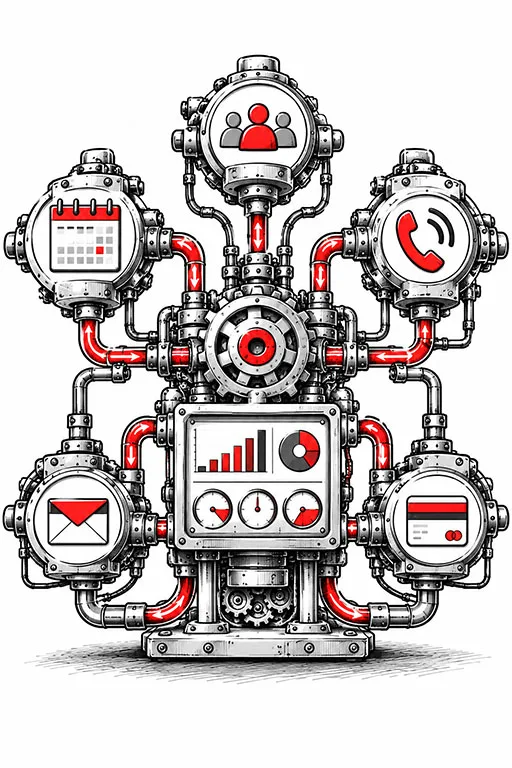
An illustration of a steampunk style business automation machine connecting various business systems and staff

The answer isn't always another software subscription.

Sometimes it's a better connection between the systems you've already paid for.

Sometimes it's a smarter workflow.

And sometimes it's discovering that one of your existing tools can eliminate the need for another.

We don't just connect software. We connect the moving parts of your business.


One Connected Business. Not Another Complicated System.

We Don't Start by Tearing Everything Apart.

You've already invested time, money, and effort in the tools your business uses every day.

We're not interested in replacing them just to sell you something new.

We start by understanding how your existing systems work, where information gets stuck, and which connections could make the biggest difference.

Sometimes the solution is a simple integration.

Sometimes it's improving your CRM configuration or automating a manual process.

And sometimes a more substantial change really is justified.

But that decision should follow a careful diagnosis—not a predetermined sales pitch.

The goal isn't to make your technology stack bigger. It's to make your business work better.

Illustration of a machine with meshed gears humming along efficiently producing neatly organized outputs


Your Profit Engine Can't Run Smoothly When the Gears Don't Mesh.

A successful business depends on coordination.

The right information needs to reach the right people. Customer interactions need to connect. Processes need to move forward without someone manually pushing every step along.

When your systems work together, your team can spend less time managing information and more time using it.

Customers can receive more consistent communication.

Important follow-ups are less likely to be overlooked.

And you can gain a clearer picture of what's happening across your business.

Less friction. Fewer workarounds. Better coordination.

You built the machine. We help make sure all the gears are turning together.


How Many Gaps Are Hiding in Your Technology Stack?


Disconnected systems don't always look broken.

Sometimes they look like another spreadsheet. Another manual step. Another employee who knows the workaround nobody bothered to document.

But those little gaps can add up.

Let's take a look under the hood and find out where your systems could be working better together.

Let's Connect the Missing Pieces →

Disconnected Business Systems & Integration | NeuroConvergent